 A few years ago I bought a book called Zhouyi Tu Jing Guang Shuo 周易圖經廣說, ‘Extensive Discussion of Zhouyi Pictures and its Scriptures’ by Wan Nianchun 萬年淳 (1761-1835). The book is more known by its original title Yi Mu 易拇, ‘The Great Toe of the Yi’. It contains Yi related pictures, and one of these pictures is an arrangement of the 64 hexagrams that I had not seen before. It is called Milun Tiandi Tu 彌綸天地圖, ‘The picture that covers Heaven and Earth’ (‘covers everything’).
At first the arrangement might look a bit arbitrary, but the key to the sequences in the four circles is to be found in the vertical hexagrams in the center: here we see the Xiantian Bagua 先天八卦 circle of the eight trigrams, doubled to make the Pure Hexagrams (chungua 純卦). In the first (outer) circle we have the hexagrams with Heaven and Earth either as top or base trigram, in the second circle the hexagrams with Lake and Mountain are given, but without the hexagrams which have Heaven or Earth in them (as these are covered in the first circle), the third circle is for the Fire and Water hexagrams (without hexagrams containing Heaven, Earth, Lake and Mountain), and the last inner circle has the hexagrams with Thunder and Wind (leaving out the hexagrams that contain one of the other six trigrams).
 The circle is also mentioned with another title, Liushisi Gua Fang Zhong Zang Yuan tu 六十四卦方中藏圓圖, ‘The circular picture of the sixty-four hexagrams in (four) regions’. In the 彌綸天地圖 the twenty-eight hexagrams of the outer circle are linked to the twenty-eight xiu 宿. In the 六十四卦方中藏圓圖 the outer circle has hexagrams linked to the twelve Branches of the Chinese calendar.
To make the inner workings of the picture visible I have redesigned it with a color for each trigram. More information about the Yi Mu 易拇 and it’s sources see this dissertation.


 If you are looking for an original present, or would like to show your interest in the Yijing in a unique way, then take a look at this webshop:
  This article contains a lot of tiny images, which makes it difficult to post it as a WordPress article. In these cases a PDF works much better. Download here:
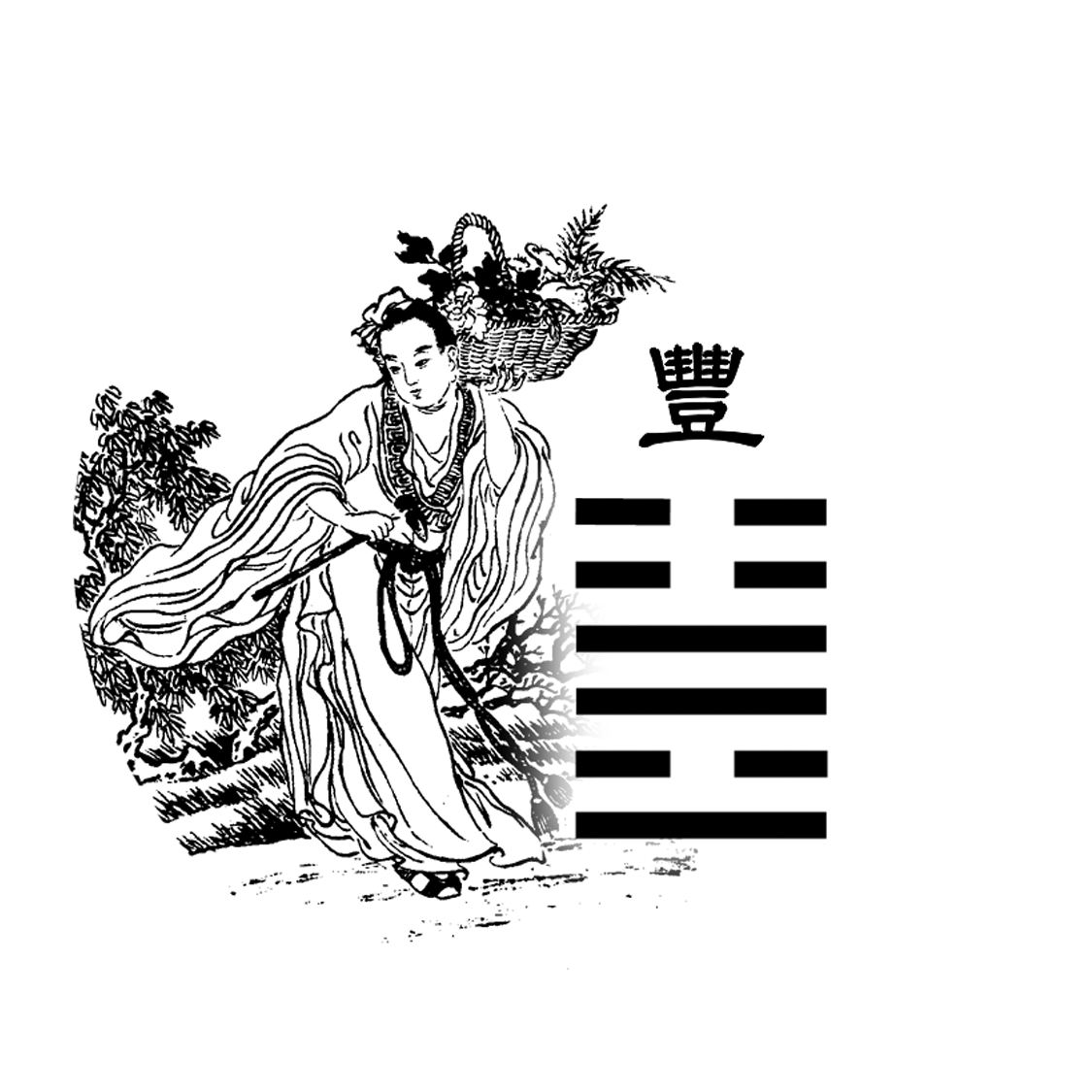 Years ago a publisher asked me to make a Yijing Agenda for the years 2000 and 2001. For attractive purposes I made 64 images of the hexagrams: 12 hexagrams for the months and 52 hexagrams for the weeks. Lately I found these images back in my archive, and I thought it would be nice to have these printed as a deck of cards.

