
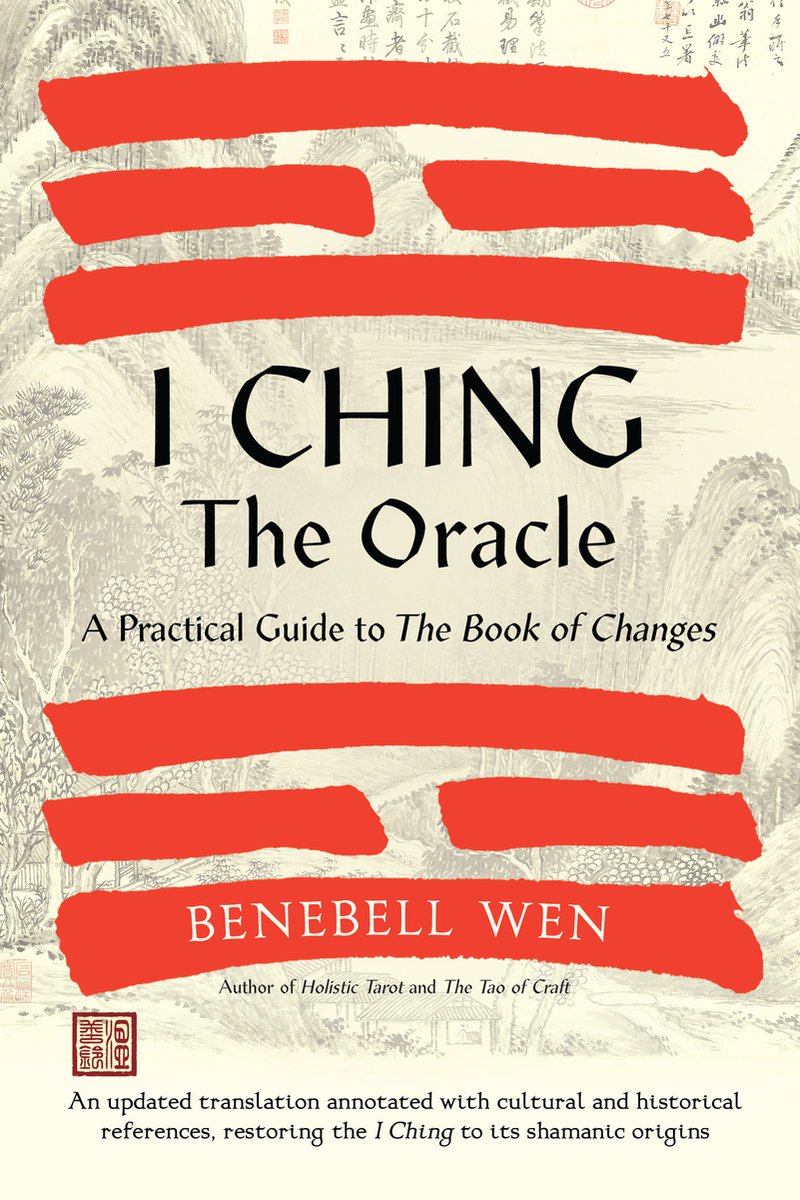
 Benebell Wen’s I Ching, the Oracle: A Practical Guide to The Book of Changes is an ambitious, beautifully produced and very substantial book. It combines translation, commentary, divination practice, ritual, symbolism, historical material and esoteric interpretation in a single large volume. It is easy to understand why the book has attracted so much positive attention: it is visually impressive, rich in material, and clearly the result of an enormous amount of work.
It is also a book with a very distinct perspective. Wen is open about her background in occultism and ritual magic, and about the fact that she approaches the Yijing through a strongly spiritual and theistic lens. I do not object to that. The Yijing has never been only one thing, and there is nothing wrong with approaching it as a living divination tradition, a spiritual text, a ritual text, a philosophical text, or a combination of these. My criticism concerns something else: in the book Wen repeatedly presents material as historical fact, scholarly interpretation or direct translation. Once a book does that, those claims can and should be checked.
 That is what I do in the two videos accompanying this article:
Benebell Wen’s Yijing translation – A Review (1)
Benebell Wen’s Yijing translation – A Review (2)
I do not discuss every possible problem in the book, nor did I read it with the intention of compiling an exhaustive list of mistakes. The examples in the videos are simply things I encountered while working through the book. I selected them because together they reveal recurring patterns in Wen’s treatment of sources, references, historical claims and the Chinese text itself.
What I expect from a translation
My main difficulty with Wen’s translation begins with her own description of it. She refers to the bold text in the translation section as a “direct translation” of the received text of the “Basic Classic.” That is a strong claim. A translation can be literal or free; it can be traditional, modern, literary, philosophical or interpretive. All translation involves interpretation to some degree. But if something is called a direct translation, then I expect to be able to see the Chinese text reflected in the English with reasonable clarity.
That is often not the case here. What Wen frequently gives us is something more complex: translation mixed with interpretation, traditional commentary, proposed character etymologies, trigram symbolism, ritual associations, cosmological ideas and Wen’s own esoteric or theistic reading. There is nothing inherently wrong with any of those things. The problem is that they are not always kept separate.
Material that would be perfectly acceptable in commentary is sometimes incorporated directly into the translation itself. This makes it difficult for a reader who does not know Chinese to distinguish between what the received text actually says and what Wen believes it means. For me, that distinction matters. I would therefore describe much of Wen’s version not as a direct translation, but as an interpretive paraphrase in which several different layers have been combined.
Translation and etymology are not the same thing
One recurring feature of Wen’s method is the use of character etymology or graphic analysis inside the translation itself. The history of Chinese characters can certainly illuminate a text. Early forms, phonetic loans, graphic components and semantic development are all important tools in the study of early Chinese. But the etymology of a word is not automatically its meaning in a particular sentence.
A character may once have been associated with a concrete image and later develop quite different grammatical or lexical functions. To translate the older graphic image instead of the contextual meaning risks producing a sentence that is vivid but no longer says what the Chinese says. This distinction becomes especially important in the Zhouyi, where the language is already extremely compact and often ambiguous. Etymology can open possibilities, but it cannot simply replace grammar and context. Several examples in the videos show that Wen repeatedly crosses this boundary.
Interpretation is not the problem
I want to emphasize this because it is easy to misunderstand the criticism. I am not arguing against interpretation. Every Yijing reader interprets, and every translator interprets. Traditional Chinese commentators interpreted constantly, often very creatively. Wang Bi, Cheng Yi, Zhu Xi and countless others did not simply repeat the text; they developed philosophical, ethical, political and cosmological readings of it. That is part of the history of the Yijing.
The problem arises when commentary is incorporated into a translation without clearly telling the reader that this is what has happened. A reader should ideally be able to distinguish at least three layers: the early Chinese text, later traditional interpretation, and the modern translator’s own interpretation. In Wen’s book those layers are often blended together. That makes the translation feel richer, but it also makes it much more difficult to evaluate.
Sources should support the claims made from them
The second major concern in my videos is Wen’s handling of sources. A footnote gives a statement authority. Most readers will assume that the cited work supports the sentence to which the note is attached. That assumption is not always safe in this book.
Again and again I found claims that were stronger than the source cited for them, claims that were different from what the cited author actually said, references without usable page numbers, and historical statements presented with much greater certainty than the evidence justified. This matters more than an occasional bibliographical mistake. A reference is not decoration; it is part of the argument.
If a source is cited to support a statement, the reader should be able to follow the reference and verify that statement. Where the cited author is cautious, the writer citing that author should not silently turn caution into certainty. Where a source speaks about one thing, it should not be used to create the appearance of evidence for something else. This is one of the strongest patterns I encountered in the book.
The problem of certainty
Related to this is Wen’s tendency to state debated, uncertain or traditionally interpreted matters as if they were settled facts. Early Chinese textual history rarely gives us that luxury. The development of Yi divination, the relationship between excavated numerical gua and later hexagram systems, the history of individual graphs, the meanings of early terms, and the relationship between transmitted texts and later commentarial traditions are all areas in which responsible scholarship often has to say “perhaps,” “probably,” “possibly,” “one interpretation is,” “the evidence suggests,” or simply “we do not know.”
That is not weakness; it is precision. A confident statement is not automatically a better statement, and sometimes the most accurate conclusion is that the evidence remains uncertain.
Why this matters to me
My own work is guided by four things: accuracy, precision, completeness and sincerity. I do not see these as separate virtues; they depend on one another.
Accuracy means trying to get the facts and the text right. Precision means saying exactly what the evidence allows, and not more. Completeness means not leaving out information that materially changes the picture. Sincerity means being clear about what is fact, what is inference, what is interpretation and what remains uncertain.
A statement can be technically accurate but misleading because important context has been omitted. A statement can contain a source but still fail as scholarship if that source does not really support what is being claimed. A translation can be imaginative and insightful but lose accuracy when interpretation is silently inserted into the original text.
This is why details matter to me. Not because every mistake is catastrophic, but because repeated small shifts can create a very different picture from the evidence on which that picture supposedly rests.
What I do appreciate about Wen’s book
Despite the criticism in the videos, I do not think I Ching, the Oracle is without value. Far from it. It is an extraordinary publishing project in terms of scope. Wen brings together a huge amount of material and clearly wants readers to experience the Yijing as something alive rather than merely as an ancient text preserved behind glass. I appreciate that impulse.
The book is also visually attractive and often stimulating. It can introduce readers to ritual traditions, symbolic systems and interpretive possibilities they may otherwise never encounter. Wen is also commendably open about her own spiritual orientation. She does not pretend that her interest in ritual, magic and theistic interpretation is absent.
My objection is not to that perspective. If the book presented itself primarily as an esoteric interpretation of the Yijing, many of my objections would simply disappear. The difficulty is that it also presents historical and philological material with scholarly authority, and describes its translation in terms that invite a level of textual scrutiny which, in my view, it does not consistently survive.
A living Yijing does not require weak scholarship
One response I have received is that a critique like mine pays too much attention to the “letter” of the text and not enough to its “spirit,” or that it approaches an Asian spiritual tradition through an overly Western academic framework. I do not find that distinction useful.
The Yijing can be a living tradition and still deserve accurate translation. It can be spiritually meaningful and still deserve correct references. A divination text does not cease to have grammar because people use it spiritually.
Nor is careful philology somehow foreign to Chinese tradition. Chinese scholars have debated wording, textual variants, phonology, graph forms, old pronunciations, loan characters, commentarial differences and manuscript evidence for centuries. Accuracy and spirituality are not opposites. A living tradition does not become more alive when historical facts are blurred.
My overall view
The two videos go into the evidence in detail, so I will not repeat all those examples here. My overall conclusion is much simpler.
Benebell Wen has written an ambitious, imaginative, visually impressive and strongly personal esoteric engagement with the Yijing. As that kind of book, it has real strengths. But I would not recommend it as a reliable direct translation of the early Zhouyi, nor would I use its historical statements or references without checking the underlying sources.
The central problem is not that Wen interprets too much. It is that the boundaries between translation, commentary, etymology, symbolism, historical reconstruction and personal spiritual interpretation are often unclear. When those boundaries disappear, a reader who cannot consult the Chinese or the cited literature has very little way of knowing which layer they are actually reading.
That is ultimately why I made these videos. Not to argue that there is only one correct way to read the Yijing, not to dismiss spiritual interpretation, and certainly not to claim that my own readings are beyond criticism. The point is much simpler: when we say that a source says something, it should say it; when we call something a direct translation, the original text should remain visible through it; and when the evidence is uncertain, our language should reflect that uncertainty.
For me, that is not pedantry. It is respect for the text, the sources and the reader.
Book details
Benebell Wen, I Ching, the Oracle: A Practical Guide to the Book of Changes: An Updated Translation Annotated with Cultural & Historical References, Restoring the I Ching to Its Shamanic Origins. Berkeley, CA: North Atlantic Books, 2023. 960 pp. ISBN 978-1-62317-873-4.
Dear Harmen
Yellowpiper here from YT. First i’d like to congratulate you in going into the ocean of WWG.
I have been following your work for a year and i really dig what you do. As said, i come from the Liu Ren Divine Arts lineage that my family practices (https://blurt.media/w/mqJrjmN9gZq4DY9kbAdRpV), though i no longer practice it myself as i feel no need to become a modern shaman.
Anywho we often use the Yi differently and today i’d like to share with you an approach to the WWG that you may find useful. Here’s me doing a WWG reading in English: https://blurt.media/w/jXxSBXso9zPZ6v7Mz9rnfP
WWG teachers mainly come from the Zhenshang Buyi lineage; often (especially in the Chinese and Hong Kong speaking world of the WWG) the Buyi principles are followed to the T. Whether it is the use of the Celestial Beasts, or the Six Relations, as well as observing the Day/Month/Year (break), and not to mention the more modern creation of the point system (not sure if you’ve seen this farce before) of determining good or bad readings.
WWG is formless and that’s why it’s so hard to learn. The basic framework can be learnt, as outlined in the ZSBY text, or the Golden Treatise and the like, but once the framework its learn it should not be stubbornly upheld.
We know (and you’ve proven) that much of what we learn about the IChing is fallacy…as it all came from the premise of Confucius having studied the Yi. He didn’t. So it’s an obvious move to transcend the text, however without a textual framework most of us get lost.
Not many can go into WWG, due to requiring us to forgo the left brained systemized framework of rules, infrastructure and queries (think programming – if this then do this). Have you ever watched or read Phillip Pullman’s “His Dark Materials”? Here’s a short video of Lyra using the Alethiometer…this is how WWG is supposed to be and exactly why it’s so hard to “learn” (it’s not really something you can “learn”….as learning means learning a system…trying to apply rules to an Ocean is silly) https://youtu.be/WtYfuEAw1bQ
[SPOILER BEWARE TAKE 5]
In the books, Lyra loses the ability to read the Alethiometer at the very end. Her right brained intuitive lateral collective unconsious mind closed off and she could no longer read the golden compass. We have to be very vigilant with our own minds when doing WWG.
In the approach i use with WWG, i do not follow the Buyi principles. In fact if you ever get the chance to interrogate some Yi/WWG masters in Hong Kong (go to Wong Tai Sin, a badass place of wholesome good vibes), you will come to know just how much BaZi comes into play, and that the BaZi principles are the forefront of any WWG reading. However we will also find that nowadays even WWG is being heavily systemized/commercialized via the Buyi lineage.
The Five elements are the crux of a formless and lateral (more intuitive) WWG reading. They say for example if you’re a dood divining about a potential main squeeze/lady then you look at the wifey line; if you’re divining about legal matters then you look for Tweety the Bird; if you’re looking for brothers in arms you look for Charizad. Yet that’s not always the case.
More-over with the modernized point system in determining good vibes and bad vibes, many intricacies are forsaken for this commercialized system (which includes using the day/month/year break to determine a positive or negative reading). This is from the Buyi lineage and is only a stepping stone.
The crux is the Wuxing, which leads us into the realms of BaZi and the associations of the Elements. However due to their interplay being different in each reading, observing cause and effect (which we are often taught to firstly look at the Subject and World lines to see what goin on) is very different and difficult compared to the commercialized, systemized approach.
Just take a look at the sixline divination iching subreddit, with those guys all up in the Buyi party, alongside their AI slop programs. This is a pity.
The ancient diviners of old heavily used their right brain allowing them a lateral experience of the world (as you know the Cantonese/Chinese language is a lateral language; the thinking mind of the Cantonese is lateral). In Chan/Zen we call it 一聞千悟 ; to experience enlightenment in a thousand ways from one doorway. With the commercialized left brain approach to WWG this is not possible.
The crux is the Wuxing and their associations, as well as the Six Harmonies, Six Clashes, Six Hams and Six Ruins. Not to mention learning to read the Four Pillars of Destiny/BaZI, this will go a long way in your WWG journey.
I believe in you Harmen. You are a bastion of light in the Yi world! And big ups for exposing Benebell Wang’s work for what it is. In the Chinese community we call her a charlatan.
If your Mandarin is good, and if you can understand that dang thick China accent, then what i have outlined can be found here (though this Master has stopped making videos, not sure where he is, but what he introduces really really changed my approach to WWG)
Hi Jin,
Thank you for taking the time to write all this — there is actually quite a lot here that I agree with, although I think we differ on some important points.
First of all, I completely agree with you that the Five Phases 五行 are the most fundamental layer of Wenwang Gua. Without really understanding 生、剋 and the changing strength and relationships of the Five Phases, the Six Relationships 六親 easily become little more than labels. In that sense I very much agree that 五行 should come first.
I would make a distinction, however, between understanding the Heavenly Stems and Earthly Branches and understanding BaZi as a system of Chinese astrology.
For Wenwang Gua, knowledge of the Stems and Branches is of course essential. You need to understand their relationships, combinations, clashes, seasonal strength, flourishing and decline, and so forth. The month and day are an integral part of classical Wenwang Gua practice.
But I don’t think that learning BaZi as a separate system of Chinese astrology is necessary for practising Wenwang Gua properly. My main reason is historical and textual: when I read the classical Wenwang Gua literature itself, I don’t see BaZi being used as the interpretive framework of the method. So unless the sources themselves give me a reason to introduce it, I am reluctant to import another system into Wenwang Gua simply because the two traditions share Stems, Branches and Five-Phase theory.
Where I think we agree even more strongly is on the danger of turning Wenwang Gua into a rigid collection of rules.
One of the things I find so fascinating about the older Wenwang Gua books is precisely that the method is not simply “if X, then Y.” There are principles and there is a technical framework, certainly, but the diviner still has to judge the configuration as a whole. Context matters. Relationships between lines matter. Sometimes one feature outweighs another. There is an interpretive intelligence involved that cannot simply be reduced to an algorithm.
This is also one of the reasons why I am not particularly fond of Wild Crane’s approach.
Wild Crane did something enormously important: he made Wenwang Gua far more accessible. By formulating rules, regularities and relatively clear “if-this-then-that” constructions, he made the method much easier to teach and much easier for people to learn. I think that is one of the reasons his work became so influential.
But there is a price to that accessibility.
To me, Wild Crane often makes Wenwang Gua look much more mechanical than it appears in the older sources. The older material seems much less obsessed with constructing a closed system of rules and much more willing to let the individual configuration determine how the principles should be applied. There is more room for judgement and, yes, for intuition.
So in a way I think Wild Crane threw the baby out with the bathwater. He helped popularize Wenwang Gua, but in doing so he also contributed to weakening precisely that intuitive and situational way of reading that I find so interesting in the earlier literature.
That doesn’t mean intuition instead of technique. Quite the opposite. Intuition without a technical foundation easily becomes projection. But technique without interpretive judgement becomes bookkeeping.
For me, the interesting territory of Wenwang Gua lies exactly between those two extremes: a very precise technical language — Five Phases, Stems and Branches, Six Relationships, Flying and Hidden Spirits, strength and weakness, combinations and clashes, and so on — combined with the ability to see what is actually significant in this particular hexagram and this particular question.
And this is exactly why I am making my current series of YouTube videos with examples taken from the classical Wenwang Gua books. I want to show how the method actually works in those older sources: not as a rigid checklist of rules, but as a technical system in which the diviner still has to make a personal, contextual and intuitive judgement about what matters most in a particular case.
That is also why, at the moment, I am deliberately going back to the older Wenwang Gua sources rather than starting from later systems and trying to project those backwards onto the tradition.
And thank you for the links and recommendations as well — I will have a look at them. 🙂
@YiTubeChannel Yes, framework is good, but the judgement comes from life experience. However without the classic WWG text we wouldn’t have such fluidity to work with.
“Discipline Equals Freedom” First we must learn the discipline/frameworks before we can freely play. I agree with the curriculum as long as it allows for fluidity of a hexagram casting’s message (but the line get’s blurred when the Practioner imposes his interpretation on the hexagram casting’s inherent message…some days my mind is not clear and i cannot make the distinction…some days i challenge myself to throw away my own imposings and to be as objective as possible….that’s where returning to the classical WWG framework helps me; then once i find my footing, i may attempt the BaZi angle!)
BaZi helps, but as you say the student Practioner chooses their own method. If it works then it should be utilized, allowing room for adaptation of course.
Many a time using the traditional frameworks, my readings are accurate on it’s own. Other times a new angle must be used, that’s the BaZi approach.
All depends on the temperament of the occassion!
You’re doing great work Harmen, you are the voice of many people. Even for me; someone with roots in HK but born in England; your videos help me understand what the Diviners were trying to impart.
Especially great is your love for the classical works; you help bridge the gap for those trapped in between such as myself. You and your work, whether the Yi or WWG, is highly valuable!
I hope i didn’t give the tone of challenging or judging your personal expression with WWG; what you’re doing is very much needed. VERY!
The beauty of the WWG is once people Wild Crane had mechanized the WWG interpretative artform, people will look towards a more fluid way of allowing the hexagram castings to express itself. Again, say it with me!
“My work is very much needed!”
😀
Looking forward to your upcoming videos. I need to eat more noodles brb!
No worries at all, Jin – I never took your comments as challenging or judging what I’m doing. Quite the opposite: I appreciate that you are engaging seriously with the method and bringing your own experience to the discussion.
And yes, “discipline equals freedom” is actually a very good way of putting it. You need the framework before you can know when the framework is helping you and when you are merely hiding behind it. That is also why I keep returning to the classical material: it gives me something solid to stand on while still leaving room for judgement, experience and intuition.
I also very much recognise what you say about the danger of imposing yourself on the reading. That is probably one of the hardest things in divination generally: distinguishing between what the configuration is actually showing and what you would like, expect or fear it to be showing. A technical framework can be a very useful corrective when the mind starts running away with itself.
And thank you for your kind words about my work. I really appreciate them. “My work is very much needed” may be a little too much for my Dutch modesty settings, but I’ll try saying it quietly to myself once in a while. 😄
Enjoy the noodles – apparently they are also part of the proper Wenwang Gua training regimen. 🍜
@YiTubeChannel Hey Harman!
My acc on YT is shadow banned to heck so msg may not relay!
BaZi principles in WWG is the crux. Wuxing, Four Pillars of Destiny combos between Heavenly Stem/Outer surface with Earthly Branches/internal mechanics, coupled with the interplay between the elements – these are to come before the Beasts/Spirits and Relations.
The Five elements gives us the entry point, and then when you incorporate the 12 stages of growth, it gives you a more fluid reading without sticking to rules and systems.
Coupled with the Six movements of Harmonies, Clashes, Harms and Ruins, that should come before using the Celestial Spirits and Relations will give you more avenues unavailable to the Buyi lineage that tries to shove a circle into a triangle.
In this sense we don’t even contemplate things such as what six relation dominates what when looking for primary intel. These are secondary. The Five elements is the crux!
///
Btw, i’m not trying to sell you anything, but blurt is a blockchain for bloggers and vloggers. Built on web3 (which means away from big tech control, especially google owned platforms). It allows anyone who makes an account to get monetized from the get go. Here’s a page about the blurt blockchain on my website: https://brave-smoke.com/blurt
please use the Brave browser as it’s very safe, secure and privacy focused. If you’re on linux then librewolf is da bomb!
It may be a great opportunity to learn about the Fediverse and how it’s changed the landscape of decentralized social media; especially for the content creator looking to supplement with passive income, tapping into the cryptocurrency powered blogging/vlogging platforms is a must.
Now i have HK in me…which means we take money and don’t give it. I do not dig the whole crypto investing crap, that’s a wall street trap. I prefer to earn it via my videos…basically doing the same thing on YT but getting paid in crypto from the get go.
On my blurt page, i hve videos showing how i cash out into electronic gift cards so that i can shop for groceries without tapping into the bank account.
There should be a link on how to create an account on the video department of the blurt blockchain, called blurt media. Then when you start posting, you earn the $blurt token, which you can then send to your own cryptocurrency wallet on your computer.
I personally convert my blurt into litecoin via trocador.app (or anything from kycnot.me is good – look for swap services), then i use bitrefill.com to convert to whatever i need….amazon gift cards…tescos….whatever).
Showing this to you in hopes you may have another avenue for a stream of revenue.
One love!