Sunday, 24 July 2005
Sinological Institute, Leiden

 A few weeks ago I was visiting the Sinological Institute in Leiden to do some research. It is a place where I can spend literally hours. Their library is one of the best in Europe, and the librarians are always willing to help you if you are stuck. It is a quiet, peaceful place and I go there as often as I can.
However, the best part of the building is not the library. It is the patio, the square space in the middle of the building which they covered with a beautiful glass-with-wood roof. Furnitured with some small tables and rotan chairs, a Chinese altar and some typical Chinese furniture it is a good place to relax.
Therefore: some photo's of the patio. More photo's of the institute can be found here.
Monday, 18 July 2005
A Mulan in the Yijing

(If you see tiny squares where Chinese characters should be you are probably using Internet Explorer. Switch to Firefox, it does a much better job.)
Through several channels the character of hexagram 44, gou 姤, has been brought to my attention. On Hilary's forum there has been some discussion about it, mainly stirred by the view of Margaret J. Pearson as expounded in her article Towards a new reading of hexagram 44 in The Oracle Vol. 2, no. 11 (September 2000). In this article she says,
"I suggest that this character 姤 be read as 'queen' 后, as did Karlgren (GSR 112) or, more precisely, 'the bride of the ruler' (king or duke) 王后, as in the Chunqiu (Spring and Autumn Annals)".
(p. 25)
There is however a problem with this suggestion, because Karlgren never said that 姤 can be read as 'queen' (thanks to Steve Marshall for mentioning this to me). Karlgren says that hou 后 is read as 'sovereign, lord' in the Shijing, as 'queen' in the Zuozhuan, and as loan for 後 in the Liji. Furthermore he says that gou 姤 is read as 'to meet' in the Yijing and as 'good' in the Guanzi (GSR p. 49-50) (this also shows that Karlgren's Grammata Serica Recensa is not a good dictionary, because he only gives a few traditional or accepted translations of a character in the context of the book in which it occurs. These meanings are often far from the original meaning of the character, as can be seen with gou 姤). But nowhere does Karlgren say that gou 姤 can be read as hou 后. Does this mean that 姤 cannot be read as 后? No, there are sources which show that this is legitimate. But these sources also have other implications for the meaning of gou 姤.
Simply put, when you read 姤 as 后, you drop the 女 radical. This is in fact a common feature in oracle bone inscriptions (See Zhang Zenglang, A Brief Discussion of Fu Tzu in K.C. Chang, ed., Studies of Shang Archeology, p. 103 and Zhang Pingchuan, A Description of the Fu Hao Oracle Bone Inscriptions, p. 124-125 in the same book). This happened with titles like fu 婦 (帚), and with clan names like hao/zi 好 (子) and jing 妌 (井). The 女 radical implies that the title concerns a woman. In other words, if you drop the 女 in 姤 and take this is a Shang feature, you imply that 后/姤 is a title or a clan name during (the later part of) the Shang dynasty.

 Let's look at the etymology of 后 for a while. When you look in the 甲骨文字典
for this character (p. 997) you are redirected to the early forms of yu
育/毓 (p. 1581). The old form of this character seems to depict a woman giving
birth to a baby (see image on the right, click to enlarge). Often, but not always, is the baby depicted upside down, and in
some instances the woman is left out (which might imply that the child part is
the important part; the meaning is the child, not the woman). Sometimes the baby carries little drops
around him, which are interpreted as amniotic fluid. That 后 is another form of
育/毓 is suggested by
Wang Guowei 王國維
(1877-1927), who saw 𠂆 as the modified 女,
and 𠮛 as a modified 子 (in
戩壽堂所藏甲骨文字考釋 as mentioned in 甲骨文字典,
p. 1581). On oracle bones 育/毓 refers to the heir, the follower, the next in
line (Tsung-Tung Chang, Der Kult der Shang-Dynastie im Spiegel der
Orakelinschriften, p. 99). It also refers to the posthumous title (miaohao 廟號) of an emperor
(甲骨文字典, p. 1582). In bronze inscriptions it too refers to the heir or succeeder
of the throne. This is in line with the Shuowen 說文,
which says about 后: "后,繼體君也".
Jiti 繼體 refers to the son of the first wife, who succeeds to the throne
("嫡子繼承帝位", 漢語大詞典, 9b.1046).

There is a similarity between the old forms of 后 and that of jun 君, which was also a title. For me this gives weight to the view that 后 is also a title.
What makes it difficult to narrow down the meaning of 后 is the matter that this character also occurs written backwards - a common feature in oracle bone inscriptions, especially with positive-negative charges of divination (the negative charge was written on the same plastron and often had mirrored characters of the positive charge). We also find this in bronze inscriptions (金文大字典, p. 1699; see also Zheng Zhenxiang, A Study of the Bronzes with the "Ssu T'u Mu" Inscriptions Excavated from the Fu Hao Tomb in Studies, p. 82-83, 96-97). This makes it difficult to distinguish 后 from si 司. On the other hand, it could also mean that there is a connection between these two, and that in order to find the complete meaning of 后 we also have to look at 司. In oracle bone inscriptions it is the precursor of ci 祠, which stands for the presenting of food as a sacrifice to the ancestors or nature spirits. But 司 can also refer to the sacrificial food itself, or the room where the sacrifice takes place (甲骨文字典, p. 997-998). In bronze inscriptions the meaning is broadened to 'administer, govern, take charge; manage', but just as with 后 on oracle bones 司 refers to 'heir' or 'inherit', and on bronzes it is also the precursor of 祠, 'to sacrifice food' (金文常用字典, p. 855).
 But 后/育/毓 and 司 are not 100% exchangeable, as the inscription on the 史墻盤 Shi Qiang pan shows. The
inscription (click image to enlarge) on this vessel contains both the character 司
and 毓. The first is with its following character,
ji 稷, the name of Hou Ji 后稷, 'Lord of Millet'; Hou Ji (personal name Zhou
Qi 周棄 or Ji Qi 姬棄; see also Shijing M245, M258, M275, M300) is seen as the first ancestor of the Zhou house and is also
worshipped as an agricultural god. The latter, 毓, is translated by Shaughnessy
as 'nurture' (Sources of Western Zhou History, p. 190), but as we have seen the character is a
picture of a woman giving birth, and we can also read it as 'bring forth
(heirs)'.
As we can see in the name Hou Ji 后稷, hou 后 is a title, and on bronzes
we know it as a posthumous title for women in high positions (The Great Bronze Age of China,
p. 183). The fact that it can be a posthumous title is strengthened by
the bronze vessels found in the tomb of Fu Hao/Zi 婦好/子. Most of the
vessels contained the name 'Fu Hao/Zi 婦好/子', but a few others contained
inscriptions which are read as Si Mu Xin 司母辛 and Si Tu/Qiao Mu 司 母. It is believed that 'Fu Hao' was the name of
the occupant when she was alive, 'Xin' her ritual name, and Mu Xin the
posthumous name. (Zheng Zhenxiang, A Study, p. 83). It is assumed that
the vessels with the Si Mu Xin and Si Tu Mu inscriptions were made after the
death of Fu Hao. The fact that the characters hou 后 and si 司 also
refer to rituals of sacrifice to ancestors and deities makes the meaning of a
posthumous title more plausible.
To summarize all this: 后 is mostly used as a title, for men, but occasionally also for women. For women it seems to have had a meaning like 'bringer of (a) heir(s)'.
It is possible that the 女 part was added to emphasize that the title is that of a woman. Which brings us back to gou 姤. This character is normally translated as 'to meet', this is mainly inspired by the Tuan 彖 and Xugua 序卦 parts of the Ten Wings, which say that 姤 means yu 遇, 遇 = '(to) meet'. Tang dynasty scholar Lu Deming 陸德明 says in his Zhouyi Shiwen 周易釋文
薛云,古文作 '遘'. 鄭同.
Xue says, the old text say 'gou 遘 '. Zheng says the same.
(漢語大字典 1045.16; 高亨, 周易古經今注, p. 285)
Xue is Xue Yu 薛虞, a Confucian scholar from the Han dynasty of who we do not know
much (Bent Nielsen, A Companion to Yi Jing Numerology and Cosmology, p.
282). Zheng is Zheng Xuan 鄭玄 (127-200), another but more influential Confucian
xiangshu 象數 scholar who wrote commentaries to the Classics (A
Companion, p. 333-334). 遘 and 姤 have the same pronunciation, which is
probably one of the reasons why they are linked to each other.
The Shuo Wen comes yet with another character for 姤, it says: 姤, 偶也. "姤 means ou 偶". 偶 has many meanings, of which one is 'a mate' or 'to mate', and this is probably the reason why several writers translate hexagram 44 as 'copulating'. But the Shuo Wen is the only dictionary which explains 姤 in this direction. There are no texts available where 姤 is used in the meaning of 'to copulate'.
Some see 姤 as a contracted form of 司母, the phrase we have seen in the Fu Hao Si Mu Xin inscription mentioned earlier. In his dissertation The Tomb of Fu Hao Kian-Chow Kwok mentions Tang Lan who "suggested that 'si' 司 (which he reads as hou 后) and 'mu' 母 (which he reads as nü 女) might be combined as a bisyllabic graph hou 姤, which meant 'queen' " (p. 50). As we have seen the character 后 is also written backwards 司, and in bronze inscriptions the old form of 母 is often similar to the old form of 女.
 There
is an oracle bone inscription which supports this view. Tang Lan reads
司母 as 姤, but the 甲骨文字典 does it the other way around: it shows an
inscription (left; click to enlarge) with a character which is composed of the components 司 and
女, and according to the 甲骨文字典 it should be read as 司母 (p. 999). 司 and 女
can be combined to si
㚸, which Virginia Kane reads as 'mother of heirs' (Art-Historical Issues
Arising from the M5 Burial at An-yang (paper), p. 23-25; quoted in Kian-Chow
Kwok, The Tomb of Fu Hao, p. 51);
 the 漢語大字典
reads it as si 媤, 'name of a girl' (p. 1041.1, 1066.2). The bronze
version of 㚸 as given by the 金文大字典
(p. 1467-1469) could equally well be seen as the precursor of 姤 (see image on the right). The 金文大字典 reads 㚸 as si 姒, a title
for the wife of an elder brother (漢語大字典,
p. 1034.3).
As always it is difficult to come to a final conclusion regarding the meaning of 姤. It is very well possible that it is the title of 'queen', but as we have seen it is probably a posthumous title. It is also possible to see it as 㚸, the wife of an elder brother. But the character also refers to a heir, and maybe the 女 part denotes a female heir, or at least a daughter of high descent. This is how I will see 姤 - for now. Let's see if the text of the Yi can give some clarification.
The Judgment of hexagram 44 says
女壯.勿用取女.
The woman is strong. Do not marry the woman.
If we assume that "女壯.勿用取女" says something about 姤,
then the meaning of si 㚸, 'the wife of an elder brother' does not fit for 姤,
after all, a married girl can not be 'taken'. The meaning of 'queen' fits better,
but if we take it as a posthumous title the sentence almost becomes a
shamanistic ritual, in which a shaman wants to be posessed by the spirit of a
deceased queen but is advised not to do so because 'the woman is too strong'.
 But then we see qu 取 with a meaning that it probably did not have.
取 normally means 'to take by force',
but the phrase 取女 is most
probably equal to the character qu 娶,
which has the same pronunciation and components, and means 'to marry' (漢語大字典,
p. 1056.1). That 取 can have the
meaning of 娶 is apparent in the
Shijing, where it is used in the meaning 'to marry' (see odes M101, M138, M158
and M261). In the Mengzi 孟子 ode
M101 is quoted, "取妻如之何、必告父母", but 取
is replaced with 娶 (Legge,
The Works of Mencius, p. 345), which shows that in this case 取 and 娶
were considered as exchangeable. And 女
might be a short form for 妻.
We have seen that 后 also refers to a woman who brought forth a heir, but a heir is only possible if the woman is married. In that case 姤 meaning 'queen' in the context of the Judgment text does not make much sense, because if the title implies that she has given birth to a heir, this also means she is already married.
Zhuang 壯 means 'strong, mighty' and it is almost only used to describe strength of boys or men. The fact that in the Judgement of hexagram 44 it is used to describe a strong woman is odd. But it might agree with the sixth line of hexagram 44, where 姤 also occurs:
姤其角.吝.無咎.
Gou its 'horns'. Regret. No misfortune.
Although jiao 角 means 'horn' it also has a lot of other meanings. One very interesting meaning is given by the 漢語大字典,namely that of the hairstyle of a boy who is becoming a man (p. 3919.1; see also 漢語大詞典 10.1345). The Liji says it is specifically the hairstyle of a boy, and that the hairstyle of a girl has another name: "男角女羈".Jiao 角 is the hairstyle for a boy, ji 羈 that of a girl.
[Update 20-07-2005] It is interesting to notice that the phrase 其角 also occurs at 34-3 and 35-6, and that in all three instances the text is not entirely positive. Further research is necessary to see what the phrase exactly means .
In the Judgment of hexagram 44 it is said that the woman is zhuang 壯, a word only used with men or boys. In the sixth line we have a girl wearing the hairstyle of a boy. The picture we get from this is that of a Mulan, a girl who behaves like a boy, which of course is highly impropriate. Such a girl is unlikely to find a suitable partner, and will surely cause regret. It is however not misfortune caused by the ancestors (the original meaning of 咎), which could mean it will pass. The girl is of high descent, no doubt that in time she will find a husband.
Thursday, 7 July 2005
To be or not to be
 Again there is somebody - whom I do not know, as far as I can see - who calls me a sinologist. If eight more people call me a sinologist, could that mean I actually am one? Maybe I should think about putting it on my business card. Harmen Mesker - sinologist. Hm, does not sound bad.
Nah. Confucius said:
The most important thing is to use the correct words.
If we don't use the correct words,
we live public lies.
If we live public lies,
the political system is a sham.
When the political system is a sham,
civil order and refinement deteriorate.
When civil order and refinement deteriorate,
injustice multiplies.
As injustice multiplies,
eventually the electorate is paralyzed
by public lawlessness.
(Lunyu 13-3)
Gee. I do not want to be responsible for that. Sorry, no 'sinologist' for me.
Monday, 27 June 2005
It Ching
Years ago I read a parody on the Yijing: It Ching by Horace Voice & Noah Fence (the names say it all). It contained a few hilarious new Yijing texts, like for instance The Image of hexagram 30, Fire:
That which seems doubly bright:
The image of fire.
Thus the man with the pants afire
feigns brightness
to impress the suckers he meets.
Unfortunately the authors did not do the complete Yijing, only a few hexagrams. Nevertheless enough material for a good laugh. The text disappeared from internet for some years but now it has emerged again. You can find it here.
Sunday, 19 June 2005
The salient
 Let's look at some early instances of 兌. The character already appears on the oracle bones, with possibly three meanings (甲骨文字典, p. 960):
- The name of a person
- meaning 閱 'to examine, investigate', mostly combined with 田 'fields'. This combination is probably equal to 蒐田, 'captures/captives of a hunt or battle'.
- meaning 銳, 'sharp, fast', mostly combined with fa 伐 'attack', making it a sharp or fast attack, probably referring to a so-called 'salient'. A salient is a battlefield feature that projects into enemy territory. It has more or less the shape of an arrow and is often applied to force a way through enemy lines, to make way for the remaining forces.
In other texts, like (the received text of) the Daodejing 道德經, 兌 refers to an opening, or forcing an opening:
塞其兌
"Block its opening...."
開其兌
"Open its opening...."
(DDJ 52)
Or in the Shijing 詩經:
行道兌矣
"Roads for travelling were opened"
(M237)
松柏斯兌
"Paths made through the firs and cypresses"
(M241)
In the Shijing we see that the meaning 'to force an opening' is used, which is exactly what a salient does. I assume that in the Yi 兌 might also refer to a salient. That 兌 can have this specific meaning can be seen in the Xunzi 荀子, where we read:
兌則若莫邪之利鋒 ,當之者潰.
'If [the army] takes its position in a salient formation, then it will be like the sharp tip of the Moye sword - whatever confronts it will be split asunder.' (J. Knoblock, Xunzi, Vol.II, p. 220)
Let us see how the meaning of 'salient' fits the line texts.
Line 1
和兌.吉.
'A balanced/well-connected salient. Auspicious. '
和 has several meanings of which many have to do with 'harmony, balanced'. It also means 'to unite, combine, integrate' (漢語大字典 1.602.1). Many meanings refer to two halves or sides which have to be equal or balanced. This is also appropriate for a salient, which consists of two sides which have to be joined and be of equal size in order to function properly. An imbalanced salient is a salient of which the two sides are not connected, or when one side is weaker than the other.
Line 2
孚兌吉.悔亡.
'A war-captives salient is auspicious. Regret disappears. '
That 孚 means 'captives of war' can be seen in oracle bone and bronze inscriptions (甲骨文字典, p. 265, 895; 金文大字典, p. 2694; 金文常用字典, p. 301; R. Kunst, The Original "Yijing" p. 150). 孚兌 might refer to a salient formed by captives of war. In the Shang and Zhou dynasty captives were forced to work on the land, but also to engage in warfare, almost equal to the so-called zhongren 眾人. K.C. Chang quotes Zhang Zhenglang 張政烺 in Shang Civilization:
"Zhongren were farmers, and were the fighting men in wars. They usually occupied a very lowly position, opposite the nobility. They had no title to land and they were securely tied up with agricultural collectives, controlled by the rulers, were conscribed to become soldiers, paid tributes, and performed labor services. When they were soldiers they would become slaves when captured, and if they refused to become soldiers they and their families would instantly become slaves also. Their lives and their possessions were controlled by the king and the nobles, being in essence their tools and possessions. (...) There is even credible evidence that this lowly labouring class was transfused with new members by means of war captives." (p. 226-227)
A salient is very dangerous for the members of the formation. Quoting Wikipedia:
The salient is surrounded by the enemy on three sides, making the troops occupying the salient vulnerable. A deep salient is vulnerable to being "pinched out" across the base, forming a pocket, in which the defenders of the salient become isolated. (...) An attacker would usually produce a salient in his own line by making a broad, frontal attack that is successful only in the centre, which becomes the tip of the salient.
For such a manoeuvre, which is likely to make a lot of casualties on the side of the attacker, war captives are convenient victims. They open the way, being followed by the rest of the army.
Line 3
來兌.凶.
'A coming/approaching salient. Misfortune.'
A salient can cause severe damage to the army it attacks. If this line is the record of an actual divination the 'misfortune' probably meant that the salient would be successful.
Line 4
商兌未寧.介疾有喜.
'The salient of the Shang has not yet been stopped. Dividing the attack brings happiness.'
寧 has several meanings of which one is 'to stop, to bring down (a rebellion)' (漢語大字典 2.949.5). 疾 not only means '(minor) illness', which is the usual translation, it also refers more generally to suffering and hardships coming from outside. It is striking that the original form of 疾 was the picture of a man being hit by an arrow - an appropriate description of an army attack using a salient (= arrow shaped) formation.
Line 5
(does not contain 兌)
Line 6
引兌.
'Leading the salient.'
引 normally refers to 'drawing a bow', and by extension means 'pull, stretch'. But it can also mean 'lead (an army)', like in the Shijing:
 以引以翼
'Leading as well as supporting'
(M246 & M252)
The 弓 component in 引 represents a bow, and it is assumed that the 丨 part refers to the stretching. If we take in mind that a salient has the shape of an arrow, the phrase 引兌 also gives the impression of a salient about to be 'launched'. An effective salient was executed fast and swift, like the firing of an arrow.
In bronze inscriptions 兌 is only found as the name of a general (金文大字典, p. 687-688; E. Shaughnessy, Sources of Western Zhou History, p. 281-283).
 The trigram image itself also gives an impression of 'breaking open', the yang lines forcing their way upwards, breaking through the (open) yin line.
Monday, 13 June 2005
National Palace Museum Taipei, Taiwan
 One of my favourite sites is the site of the National Palace Museum in Taiwan. Beautiful pictures and a lot of information. Check for instance the section with past exhibitions. My favourite one is A Special Exhibition of Bronze Inscriptions from the Western Chou. The introduction is a good entry into the world of bronze inscriptions. Other ones are Ancient Writing from the Ruins of Yin (about oracle bones) or a Special Exhibition of Shang Period Ritual Bronzes.
I can spend hours on sites like this.
Tuesday, 7 June 2005
My references
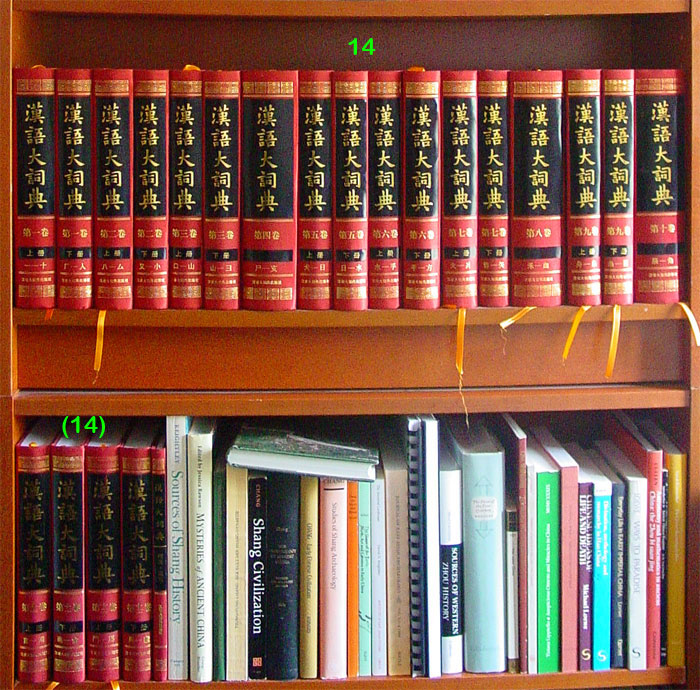
I have received a few requests for more information about the dictionaries I use and other books I use for reference. Maybe this helps. Click on a picture for an enlargement. Clicking on book titles shows detailed (mostly Amazon) information.
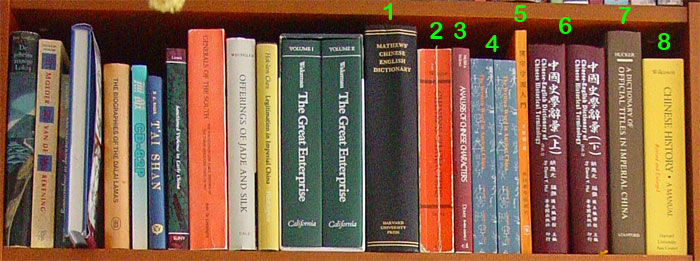
1. Mathews' Chinese-English Dictionary
2. Chinese Characters
3. Analysis of Chinese Characters
4. The Written Word in Ancient China
5. The Origins of Chinese Characters
6. Chinese-English dictionary of Chinese historical terminology
7. A Dictionary of Official Titles in Imperial China
8. Chinese History: A Manual, Revised and Enlarged
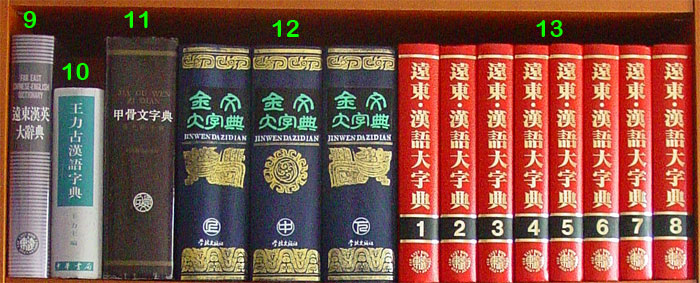
9. Far East Chinese-English Dictionary
10. 王力古漢語字典
11. 甲骨文字典
12. 金文大字典
13. 漢語大字典
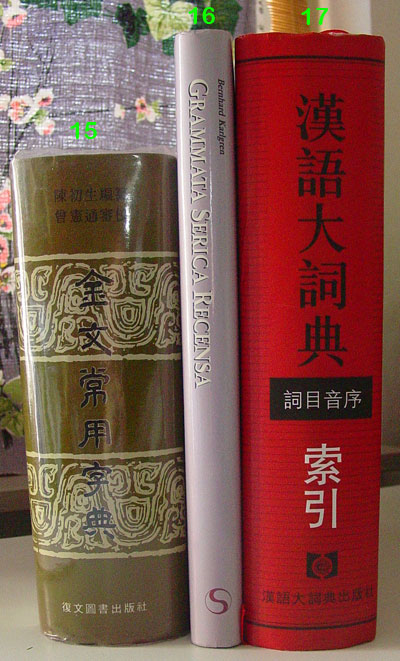
15. 金文常用字典
16. Grammata Serica Recensa
17. 漢語大詞典詞目音序索引 (index to 14 - 漢語大詞典)
Thursday, 26 May 2005
Shanghai Museum Chujian Zhouyi
Books can make me happy, but the book I received today thrills me with excitement. I finally received a copy of the Chujian Zhouyi, aka the Shanghai Museum manuscript of the Zhouyi (to read more about it see Edward Shaughnessy, A First Reading of the Shanghai Museum Bamboo-Strip Manuscript of the Zhou Yi, forthcoming). It is the oldest (but not complete) copy of the Zhouyi we have today; it is estimated around 300 BC.
In the Spring of 2004 the Chujian Zhouyi was published. Shaughnessy writes about this book:
(...) this third volume is sumptuously produced. It begins with a two-part section of photographs of all the strips: first, half-size full-color photos of all of the strips arranged in what the editors believe was their original order, and then enlarged full-color photos in which each strip occupies a single page. This introductory section is then followed by an 83-page section of transcription and detailed commentary written by Pu Maozuo 濮茅左, a senior curator at the Shanghai Museum. As in earlier volumes, this section begins with a brief overview of the text, including its physical properties, format, general paleographic considerations, and, in this case, the place of the manuscript in the textual history of the Yi jing. This section proper consists of strip-by-strip presentations of the text. Also as in previous volumes, each strip is introduced by yet another photograph, this one full-size and black-and-white (though certain symbols that are red on the original strips seem to have been hand-colored in these photographs). There then comes a detailed description of the physical characteristics of the strip, including especially notation of any breaks and/or rejoinings. Finally comes a phrase-by-phrase discussion of the text on the strip, each of which is followed by how the phrase reads in the silk manuscript of the Yi jing that was discovered thirty years ago at Mawangdui 馬王堆, in Changsha 長沙, Hunan, and also how it reads in the received text. The presentation of the Zhou Yi includes also two appendices. The first, 35 pages long, is a line-by-line comparison of the Shanghai Museum manuscript, the silk manuscript from Mawangdui, and the received text of the Zhou Yi; entries for both the Shanghai Museum and Mawangdui manuscripts include both photos of the original manuscript and also direct kaishu 楷書 transcriptions. The second appendix, 10 pages long, is a study of six different black and/or red symbols that are included with each of the hexagram texts of the manuscripts. Publication of the volume was delayed apparently because of a flaw in the coloring of these symbols in the first print-run, necessitating the withdrawal and reprinting of the entire edition. This is a manifestation of the care that has gone into the editing and publication of all of the Shanghai Museum manuscripts. Although this volume, like most paleographic publications, has already met with various types of criticism, mainly from scholars in China, the scholarly world is surely much in the debt of all those who have worked so hard to make these manuscripts available.
The book measures 44 x 30 cm in size, the quality of the paper, printing and binding is excellent, in all, it is a pleasure to look at. I don't even dare to read it, afraid that I will spoil the pages!
The next few weeks I will examine the book and the manuscript carefully. If I find anything interesting (of course I will) I will let you know.
上海博物館藏戰國楚竹, Vol. 3
ISBN 7532530140
Below are some samples of pages.


Saturday, 14 May 2005
The banner of 'qian'

There are a lot of things you have to keep in mind when you investigate the character qian 乾 from hexagram 1. First, there is the problem of finding the right components which form the character. Your first impression would probably be that the character consists of the component  on the left side, and 乞 on the right side. This idea would probably be strengthened by the fact that there are more characters with as a component, like 朝 or
 . The last character was written in bronze inscriptions like this (金文大字典, p. 2517):

And if you link this old form to 乾 you might be inclined to think that is the sun among trees or something similar and use this finding in your interpretation of 乾. But is not a component in 乾, we have to add the top-right part of the character as well, which makes the complete component  (full form 倝). This is the true, and most meaningful part of the character 乾.
is often recognized as the earliest form of 乾. The online Dictionary of Character Variants gives variants of , including  , which according to the 漢語大字典 (p. 1529-1) is similar to
 (p. 2222-10), which is the same as 乾. Of course you have to be careful with using such detours, but it shows that is the significant part in 乾.
To find some meanings of this component the Shuowen 說文 surprisingly put me on the right track. I usually hesitate to use the Shuowen dictionary, because it often gives fancy descriptions that have nothing to do with the oldest form of a character. [27-05-2005 See about the reliability of the Shuowen (and Wieger's Chinese Characters) the entries by kentsuarez in this thread.] But in this case the Shuowen proved helpful. It says about 倝:
倝,日始出,光倝倝也。從旦, 聲.
'Qian, the sun starting to appear, its rays qianqian 倝倝. From 旦 'daybreak', as phonetic.'
The first part, 'the sun starting to appear, its rays qianqian' is an odd description of a character, and a Western dictionary would never get away with this. It is like defining the word 'walking' like "walking, the feet walkingwalking". But it should put you in the right direction: when the sun comes up the rays of the sun qianqian. Possibly this means that the rays of the sun get brighter and brighter, increasing its intensity while the sun is climbing higher.
At least two things in this sentence from the Shuowen are fascinating. First, the Shuowen speaks of qianqian 倝倝, and this reminds me of the only text in hexagram 1 where the character qian 乾 appears, namely line 3. Here it says
君子終日乾乾.
'The junzi all day long qianqian.'
Here we have the character 乾 repeated, just like 倝 in the Shuowen. This doubling of the character, and its place in the sentence, suggests that 乾 is a verb, the doubling also suggests continuity or intensity: it goes on and on. Richard Kunst says about this reduplication:
There is such a pronounced tendency in both the Shijing and the Yijing to describe junzi with one or another reduplicated expression that we may define the pattern "junzi X-X" or "X-X junzi" as a literary device, a kind of an epithet for the nobility.(The original "Yijing", p. 397)
With the description from the Shuowen in mind, we get the picture of a junzi who works on his position all day long, extending the rays of his influence.
A nice interpretation, but there is another interesting fact in the sentence from the Shuowen. It says "聲", meaning " as phonetic". This is odd, because is clearly different from . Is the Shuowen suggesting that is the same as ?
 On oracle bones and bronzes is written like this (漢語大字典, p. 2174-1; picture on the right is after 楊英杰, "先秦旗幟考釋", Wenwu, 2 (1986): p. 52-56, as mentioned in James C.H. Hsu, The Written Word in Ancient China, p. 878; Wang Hongyuan 王宏源, The Origins of Chinese Characters ("漢字源入門"), p. 155):

The banner was very important in ancient times. The place where the banner was set up indicated the place where the tribe was stationed. The banner was often raised high in the air, so that everyone could see it, and usually accompanied the commander into battle (...). The people of many tribes built their villages in the shape of a square or a circle in order to emphasize the fact that they were of the same blood and shared community and defensive concerns. Yangshao culture villages were constructed on this pattern. All the houses in a circular village faced inwards towards the large building used for gatherings which was built in the centre. The banner was usually set up near it. Therefore, the oracle bone graph(modern character zhong 中 "center", "middle") shows a place marked with a pole, which may or may not have had banners attached to it
, indicating a certain area with a banner pole at the centre. In some oracle bone inscriptions there are divinations made by the king in which he asks whether there will be a strong wind on the day when he establishes "the centre", no doubt the place where the banner would be set up. From this we know how important the place was where the banner was set up and that this practice strongly reflected earlier tribal organization. (p. 838)
Drawing of a pole with some decorative streamers. The pole was placed in the center of a circle or dial so that a shadow cast by the sun on a calibrated dial could measure solar time - much like the gnomon or style of a sundial. (Wang Hongyuan 王宏源, The Origins of Chinese Characters ("漢字源入門"), p. 195)
This sundial principle reminds us of the sun 日 part of the component , as already mentioned in the Shuowen. There is a resemblance between and ; we might surmise that they share a common origin which points to banners. [18-05-2005 James Hsu confirms in a personal e-mail that 乾 might be related to a sundial.] Whatever path you choose, the meaning of banners in seems unavoidable. This is even more the case when we look at the old forms of . On bronzes the character is written like this (漢語大字典, p. 169-4):

The big 金文大字典 dictionary gives a lot of interesting information about 倝 (p. 5430). It quotes Xu Zhongshu 徐中舒 (1898—1991), the late expert on oracle bones inscriptions, who says that 倝 is the original character of 韓 (also written as 𩏑) and 榦. In bronze inscriptions 榦 has the meaning of 'to support' (金文常用字典, p. 615-616). 韓 was the name of a feudal state around 1100 BC. which bordered the Western Zhou region and had to pay tribute to the Zhou. Ode M261 from the 詩經 is devoted to this state. A feudal state brings and receives support. But 韓 and 榦 also share a common meaning, namely that of 'railing of a well'. A railing is some kind of border. I mention this because it comes in handy later.
The 金文大字典 also brings to our attention an oracle bone character which has to do with banners & support:

Three men are supporting a banner. In all instances that are found of this character the pole (in Chinese also described with 榦) has shapes like  ,
 ,
 or
 . These might be the precursors of the component
 in the bronze form of 倝.
In other words, gone is the meaning of 'The 日 sun rising behind the trees of the jungle', as Karlgren says (Analytic Dictionary of Chinese and Sino-Japanese, 299; quoted in Wenlin). and are pictures of banners, and if we want to find a meaning of 乾 we have to take this into account. This idea of a banner or flag in 乾 is already mentioned by Hellmut Wilhelm, who writes in his Sinn des I Ging:
The primary element in this character appears to be radical 62 (戈), which represents a flag pole. In the old writing it was depicted by a planted halberd with a yak's tail fluttering from it. It was the symbol of the commanding authority in the army. To this primary element two meaning additions ("Bedeutungszusätze") were added. The first is the word for 'sun', but not the sun as a heavenly body but as a light giver, a word we also find in the character yang 陽, one of the main principles in ancient Chinese philosophy. The second meaning addition is the character for 'water'. (p. 40)
In a footnote Hellmut thanks his colleague Erwin Reifler for his help in the analysis of the character. Reifler's studies of Chinese characters are not entirely undisputed, to say the least, but in this case he seems to be quite right, even if he regards as 戈, a character which in its old form is close to the old form of .
 But there is another character which has a remarkable resemblance with the bronze form of . The character 岸 looks very similar, in its modern form, but also in its old form. It has several meanings, but the ones that are of interest here are (漢語大字典, p. 766-4)
- raised land that borders a river, lake or see (靠江、河、湖、海等水邊的高地)
- boundary (邊際)
- same as 犴, village prison (鄉間牢獄)
- metaphor for a high position (比喻商位)
These meanings are similar to that of 韓 and 榦, which share the meaning 'railing of a well'. The character 岸 adds to this a high position, as James C. Hsu said, "the banner was often raised high in the air, so that everyone could see it".
There is another thing which connects all the characters I have mentioned so far: they are all close in pronunciation, which might point to their common origin, the component :
| 乾 倝 㫃 韓 榦 岸 | gan/qian gan yan han gan an |
I do not have the proper sources to check how the pronunciation was round 1000 BC, and there is a big chance that it was different in that time. Nevertheless it is remarkable that today all the characters have at least the same final (weiyin 尾音).
Having said all this, it is difficult to come to a conclusion about the meaning of 乾 in line 3 of hexagram 1. My personal guess is that line 3 is a lamentation of a junzi: he always has to be worried about his position and how he can be of support to the king, and can get support in return. This explanation will probably not satisfy you and might even be dissapointing after this detailed exposé, but it is not my style to come with elaborated wild assumptions which are not 100% percent backed up by facts. And facts, well, they are hard to get in this field.
Monday, 25 April 2005
Die plank
 Irian: "Harmen, hoe heet de baas van de wereld?"
Harmen: "Huh? De wereld heeft geen baas."
Irian: "Nee, ik bedoel de baas van óns! Wie is onze baas?"
Harmen: "Onze baas? Je bedoelt van Nederland?"
Irian: "Ja, van Nederland. Die plank."
Harmen: "Die plank? Ik weet níet waar je het over hebt."
Irian: "De baas van Nederland! Die plank!"
Harmen: "....."
*plink* (muntje valt)
Harmen: "Ooooh, je bedoelt Balkenende!"
Irian: "Ja. Die plank."
Language
Huanying, huanying!
Many people (including me) have problems viewing the Chinese characters on my site. Even Firefox, which is the best browser for it, does not always do the job right. To help visitors viewing the articles I have converted some of them to pdf format, which can be viewed with Acrobat Reader. If you see this icon

at
the beginning of an article, you can view that article as a pdf by clicking on the icon.
Disadvantage of these pdfs is that you cannot click links, or images
for enlargement. So keep it alongside with the original web article and
you should do fine.
Categorieën
Zoeken
Add me to your blog, FB, Twitter...

