Wednesday, 20 April 2005
The misconceptions of Robert G. Benson

"I am highly critical of almost all popular I Ching books available today. My successes using the I Ching, and the dismal state of this area of knowledge, have compelled me to produce this book. (...) recent research leads to the conclusion that no translation can accurately represent what the I Ching truly is. None of the I Ching books currently on the market shows how the I Ching is actually a comprehensive philosophical statement about how our lives undergo change. Perhaps even worse, none are an effective practical guide to using the I Ching. I wrote this book to say what hasn't been said before. I wanted this book to open new doors -- to be a breakthrough book for novice users, but to also be filled with critical insights for experienced users".
I have not bought his book, nor do I intend to. After all, when a writer states that none of the Yi books currently on the market "are an effective practical guide to using the I Ching", he is definitely not up to date with this field of study, and that makes me lose all interest in his work (see also Hilary Barrett's point of view). But that is not my major concern here. A writer can write what he wants, as long as it is backed up by facts or reasonable arguments. But more than thirty years of studying (who knows what) does Benson make false statements about a subject he is obviously not very familiar with:
A Warning about "Astrology of the I Ching"
There are a few websites which contain computerized versions of Shao Yung's Astrology of the I Ching. The information for these comes from two published work by Chu and Sherrill (in The Astrology of I Ching and An Anthology of I Ching). I have done extensive research into this system and inspected it in both these sources. This is indeed a remarkable system, but unfortunately I've found that there are two "transmitted errors" in one of the key tables. (I use this term because the error is egregious, and clearly cannot come from the originators, who were experts in the I Ching). Using this table UNCORRECTED means that the system CANNOT EVER give answers using hexagrams 30, 38, 49, and 58, and will give incorrect answers SOMETIMES using hexagrams 10, 13, 14, 17, 19, 21, 22, 28, 31, 35, 36, 37, 41, 43, 45, 47, 50, 54, 55, 56, 60, 61, 63, and 64. Thus, 28 of the 64 hexagrams (44% by number) are being incorrectly or inconsistently reported! I have communicated this fact to authors of some of these programs, but I have no knowlege if they've researched this, or used the correction (which I've published in a footnote in my book). This fact is very significant, because these programs cost money, and yet are worthless. Also, unfortunately both Chu and Sherrill are deceased. Therefore, I DO NOT recommend using ANY programs based on Chu and Sherrills materials for the "Astrology" system unless this correction has been applied to that table. As always, caveat emptor (buyer beware)!
His statement contains several errors. First, although a lot of divinatory systems (including Meihua Yishu, plum blossom numerology) are attributed to Shao Yong, none of them are to be found in Shao's work. The attributions are apocryphal. But this is a minor error.
What is worse is that he claims there is an error in table 13 of Chu & Sherrill's Astrology of I Ching, 'The earthly numbers and trigrams' (as said in e-mail correspondence). You need this table to calculate one of the two trigrams that make up your 'birth hexagram'. In this table there are the even numbers 2 to 60, and each number is assigned a trigram. 2 = Earth, 4 = Wind, 6 = Heaven, 8 = Mountain, 10 = Water, etc. Number 20 and 50 are also assigned the trigram Earth.
And that, says Benson, is wrong. They should have the trigrams Lake and Fire, he says. He wrote in an e-mail to me how he found out about this error: he calculated the hexagram of a person, and the outcome was.....wrong. And because he found the answer was wrong, the system had also to be wrong.
That is odd. How could the answer be 'wrong' when it is only a hexagram you get and which you have to interpretate? A hexagram can hardly be called 'wrong', the only trouble you may have is with the interpretation. It is possible you may not understand the answer. Also, by now millions Chinese have used this system with satisfaction. Also in the West many find the system does work and gives accurate results. They are able to work with the answers they get, but at some point Benson was not. Does that make the system 'wrong'?
But the table in S&C's book is not wrong. The original Heluo Lishu document contains no table, but rules for the calculation of the Earth trigram. The table in the book is based on these rules (in this order):
- If the Earth number is larger than 30, substract 30. If it is still larger than 30, again substract 30.
- If the Earth Number can be divided by ten, discard the zero.
- If the Earth number is larger than 10, substract 10.
S&C put these rules in a simple table. Let's try these rules with the numbers 20 & 50. 20 can be divided by ten, therefore we discard the zero. The result is number 2. For number 50 we substract 30, which leaves 20. We discard the zero, which leaves 2.
To find the corresponding trigram you have to look at the houtian trigram circle combined with the Luoshu (see this image). Number two corresponds with the trigram Earth. In other words, the table in S&C's book is correct.
Benson also says "Using this table UNCORRECTED means that the system CANNOT EVER give answers using hexagrams 30, 38, 49, and 58, and will give incorrect answers SOMETIMES using hexagrams 10, 13, 14, 17, 19, 21, 22, 28, 31, 35, 36, 37, 41, 43, 45, 47, 50, 54, 55, 56, 60, 61, 63, and 64". This is not quite true. It is true that it is impossible to get hexagram 30 and 58. That is not a flaw in the system, it is simply the consequence of the rules because the calculations for the Earth trigrams only use even numbers, and the trigrams Fire and Lake have numbers 7 and 9. It is impossible to get 7 and 9 as final outcome of the Earth trigram calculations, and the consequence is that you can never get hexagram 30 and 58. But it is a consequence with a reason behind it. Heluo Lishu deals with human matters, it tells about people's character and how they will function in society. Hexagram 30 deals with Knowledge & Wisdom: according to the Chinese vision nobody is born with K&W, you have to acquire it during your life. The same goes for hexagram 58: Happiness in its most essential and fulfilling form is something you have to learn, you do not get it on a silver plate when you are born (after all, being born is very traumatic, that's when the trouble starts). Hexagram 30 & 58 are impossible to get, but all the other hexagrams Benson mentions are possible as outcome.
It is easy to say that a table is wrong when you don't know the rules behind it. Instead of writing that the system (or a part of it) contains errors, just because he doesn't know or understand the background of it, Benson should better have checked his findings with someone who is acquainted with the original Chinese material.
Saturday, 16 April 2005
Doubt
In reply to an entry in Hilary's weblog:
Many who have been working with one translation for years often become confused when they see another translation which differs quite from theirs, but is more true to the original Chinese text. What to do? Still use your old book with which you were comfortable for all these years but which now has breaches in its outer layer of perfection? Or use the new translation which fits like new shoes - uncomfortable yet, but walking probably makes it better? If you choose the latter, how about all these years and the answers you got from your first book? Should the answers you got through all these years have been better if you used this new translation instead? Doubts arise.
But the problem is not the book, it is what you do with it. In the end it doesn't really matter if the book you use is close to the original Yi or not. If you value the book, if it enriches your life, if you draw inspiration from it, if it helps you and you are not concerned about the Yi and its history and origin - then what does it matter if it is THE Yi or something entirely different? As an ordinary user you shouldn't be bothered by questions about origin and originality - you should be selfish and think about your own concern only. If a new translation doesn't give you what you need, and you have walked all possible ways to comprehend it, then stop punishing yourself and use what you are familiar with.However, if it is important to you that you use a book which is as close to the original Yi as possible, in other words you want to use the Yi as an oracle and not any other book, then you will have to get used to using a new translation every now and then. You will have to learn to cope with doubts, and integrate them in your learning process.
"People who do not doubt simply have not devoted themselves to concrete practice. If they have concretely practiced, there must be some doubts. Something must be impractible, and that raises doubts. (...) The student must first of all know how to doubt. (...) Combine the internal and the external into one and regard things and the self as equal. This is the way to see the fundamenal point of the Way."
- Jin-si Lu: 'Reflections on things at hand'
Use doubt to your advantage. There is no difference between You and the book you use. After all, every book can be used as an oracle. What matters is how the book fits you. The Yi does not serve everybody.
Wednesday, 13 April 2005
Some observations

Guān 觀 consists of two parts: 雚 and 見. Most etymological dictionaries quote the Shuo Wen 說文 which says that 雚 represents the pronunciation 'guan', and that 見 gives the meaning 'look'. But according to the 甲骨文字典, 雚 is the precursor of 觀 (p. 979 and 408-409). It is more than a phonetic component, it definitely adds meaning to 觀.
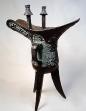
雚 is rarely mentioned in Chinese texts, it mostly occurs as a component in other characters (觀, 權, 歡, 灌, 勸, 罐,顴 etc.). The Shuo Wen 說文 says that 雚 is a "小爵" (漢語大字典 4104.2), an ancient wine vessel with three legs and a loop handle. This seems to be correct, as Karlgren says about 爵: "Cup for libations or feasts; noble, nobility, dignity, rank -- cf. 尊; originally a picture, in the small seal altered so as to contain 鬯 aromatic herbs and 又 hand; now still more deformed; the cup had the form of a bird; 爵 and 雀 'small bird' are etymologically the same word, hence 爵 is sometimes used for 雀" (quoted in Wenlin). The fact that a 爵 had the shape of a bird, more specifically a heron, is significant here, because 雚 contains the component 隹 'bird'. (But I don't understand why Karlgren says that 爵 and 雀 are etymologically the same word, because according to the 甲骨文字典 their shapes are entirely different. But we will take that for granted.) The 吅 component in the character might represent the two knobs which are used to carry the vessel after the wine has been warmed. That 吅 can represent these knobs can be seen in the character 斝, which is also an ancient type of vessel which has these knobs (see here).
The 甲骨文字典 says that 雚 and 雈 (not to be confused with 萑) are exchangable. In oracle bone inscriptions 雈 can be the name of a sacrifice, the name of a place, of a person, or synonym to 觀 'look', or the same as 舊 'old'. Tsung Tung-Chang adds: "  (variants
 ) is identical to 雈 = an owl with feather horns (according to the Shuo Wen HM), (...) 雚 = 鸛 = 'ciconia boyciana'. In oracle bone inscriptions it is used for the homophone verbs 灌 = 'pour wine' and 觀 = 'look at'." (Der Kult der Shang-dynastie im Spiegel der Orakelinschriften, p. 65).
The chance that 觀 has something to do with offerings is enlarged by the Judgment of hexagram 20: 盥而不薦.有孚顒若. "Washing
the hands yet not sacrificing. Having captives (of war) looking up,
which is in order". This text deals with offerings and sacrifices.
But what is then the meaning of the component 見? If 雚 represents the wine vessel (covered up 艹 because it is not yet used?) for the libation or the libation itself (灌), then what does 見 add to it? It seems as if it refers to the persons who are not carrying out the sacrifice, but are viewing (見)
it. They are observers, and maybe their job was to look for omens which
might occur during the service, as a sign of the gods. They 'wash their
hands but do not sacrifice'. They only observe.
Hexagram 20 could describe different kinds of looking at the sacrifice, for instance, 童觀
in the first line could denote viewing the sacrifice from within a
barren field, or from the top of a mountain which has all the
vegetation cut down for a better view (for this meaning of 童 see 漢語大字典 2711.9).
Monday, 11 April 2005
Anton Heyboer (1924-2005)
Wednesday, 6 April 2005
The far place
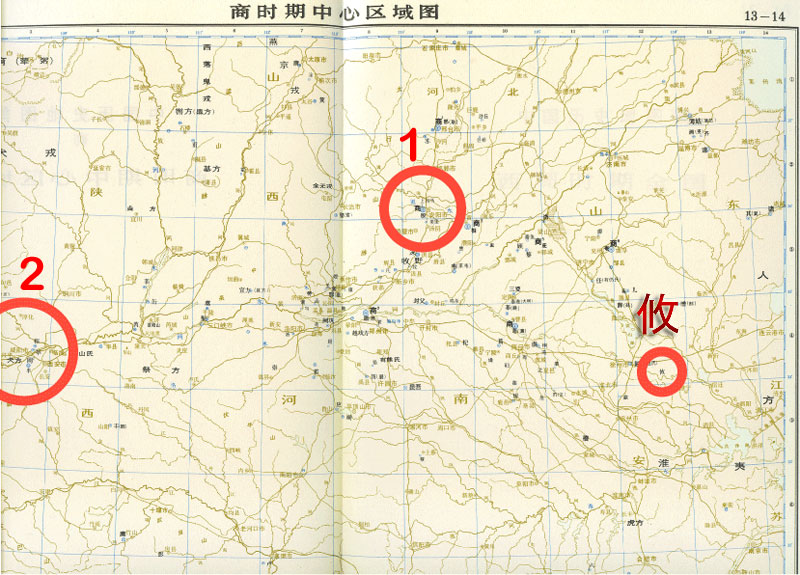 The character you 攸
already appears on the oracle bones from the Shang-dynasty (ca. 1750 -
1122 v. Chr.). As we see it know it referred to a specific place, city
or area (Jiaguwen Zidian 甲骨文字典,
p. 336). According to my historical Atlas it was a area in the current
region of the Fei Huang river, in the North of the province Jiangsu (see map).
However, when it comes to the Shang dynasty historical atlases are not
always reliable, after all there is no material at hand which says
'this place was there', which makes filling in the Shang map a bunch of
guesses.
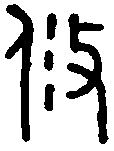 On bronze inscriptions from the Zhou-dynasty (ca. 1122 - 221 BC) the
character also often occurs, mostly in two meanings. One meaning
doesn't seem to be of interest to us, because in this case it is always
used in combination with le 勒.
It seems to refer to the bronze ring which kept the reigns of horses
together. But this meaning only goes for this specific combination of
characters, and we don't find this in the Yi. The meaning which is of
interest to us is that of 'long (ago)', or 'far (in distance)'. On
bronze inscriptions the character is often a synonym for xiu 修 or you 悠,
and if you look closely you will see resemblances between the
characters. If a character got more meanings in the course of time,
making it difficult to understand which meaning was meant in a text, to
add an extra component which pointed to the meaning the writer
intended. On the Zhongshan Wang Ding 中山王鼎 tripod from the Zhanguo-period (481 - 221 BC), which was found in 1977, we find the character with the meaning of 'far'. We also know texts where you 悠 with the meaning of 'far' is written as you 攸 (Jinwen Da Zidian 金文大字典 p. 430).
I suspect there is a connection between the Shang meaning of you 攸 and the Zhou meaning of you 攸. During the Shang dynasty it was a specific location, somewhat far from the (last) capital (see map, no. 1 is the last Shang capital), but not too far (about 300 kilometres). The Zhou capital however was far more to the West (no. 2), and much further from the You 攸 area - about 700 kilometres, assuming the historical atlas is right. Maybe you 攸 in the time of the Zhou did not refer to the location You anymore, but was used more general in the sense of 'far away'. The Yi is supposed to be written during the Zhou dynasty, so maybe in the Yi you 攸 also means 'far'. Let's see what this gives us.
In the Judgment of hexagram 2 we read: 君子有攸往. Wilhelm says "If the superior man undertakes something...", Huang says, "Superior person has somewhere to go", Boering says "The student can undertake something". But if we translate you 攸 as 'far', then a (somewhat literal) translation would be: "The Junzi has far to go", in which we can see you 有 with a little enforcement, like 'must' or 'sensible, good to'. You 攸 seems to refer to the areas far from the capital, the outer regions at the border of the land that was under control of the Zhou. This assumption seems to be confimred by The Judgment of hexagram 3, where it says 勿用有攸往. 利建侯: "not execute/use far travels, (more) favourable (is it) to appoint feudal lords". In this case it seems better for the king to leave the far regions to helpers who do the work for him.
As said the character you 攸 appears 32 times in the Yi. Within these 32 instances we can discern 5 patterns:
1. 利有攸往: 24-0, (25-2,) 26-3, 28-0, 32-0, 41-0, 41-6, 42-0, 43-0, 45-0, 57-0, 22-0
2. 無攸利: 4-3, 19-3, 25-6, 27-3, 32-1, 34-6, (37-2,) 45-3, 54-0, 54-6, 64-0
3. 有攸往: (2-0,) 14-2, 36-1, 40-0, 44-1
4. 不利有攸往: 23-0, 25-0
5. 勿用有攸往: 3-0, 33-1
I see youwang 攸往 here as a journey to the borders of the empire. Wang means as much as "commence a journey" (Jinwen Changyong Zidian 金文常用字典; p. 197). In the bronze version of this character we find the component wang 王,
'king'. Normally it is said that this component represents the
pronunciation, but in my view it could also point to the meaning: it is
the king who goes.
The examples below give the idea that it is only good to undertake a youwang when at the home front everything is in order.
Pattern 1: 利有攸往
"Favourable to have a youwang".
For example
26-3: 良馬逐。利艱貞。曰閑輿衛。利有攸往。"A
chase with good horses. Favourable to have a hard times divination. It
is said, use chariots as blockade for defence. Favourable to have a youwang."
Jian 艱 means 'hard, difficult times' (金文常用字典; p. 1097, Jiaguwen Zidian 甲骨文字典; p. 1464). A divination was not only done to know what would happen, but mainly to decide what would happen. It was an arrangements with your forefathers. You take care of their wellbeing by bringing offerings, they make sure there will not take place any calamities. This is also found in an additional meaning of jian 艱: mourning about the death of (one of) your parents (Hanyu Da Zidian 漢語大字典;
p. 3171). After their death your parents are capable of sending you
luck or disaster, therefore you have to be assured of their support.
A
'hard times divination' could be used in difficult times (or after the
death of a parent) to get the support of the ancestors. With that
support, and with good material, it can be favourable to have a youwang.
Pattern 2: 無攸利
"No profit from the you". From the border regions comes no profit.
For example
4-3: 勿用取女。見金夫。不有躬。無攸利。"Do not use 'taking the woman'. The bronze worker has to be seen. Do nothing personal. From the border regions comes no profit."
Qu 取 mostly means 'take, appropriate'. In Shang it was probably also the name of a offer ritual (甲骨文字典; p. 292). That would make a 取女 a woman who is being offered, probably to get something. In bronze inscriptions was qu 取 Also een shortening for zou 郰, the name of a city (金文常用字典; p. 292). This would make 取女 'a woman from Zou', but this is unlikely.
Tsung-Tung Chang says in Der Kult der Shang-Dynastie im Spiegel der Orakelinschriften about qu 取: " ist
identisch mit dem heutigen Zeichen 取. In Orakelinschriften hat es,
außer der heute üblichen Bedeuting "nehmen", auch die Bedeutung
"Kulthandlung". Hsü Shen erklärte die Struktuur dieses Zeichens met dem
alten Brauch, das linke Ohr des erlegten Wildes oder des erschlagenen
Feindes als Trophäe abzuschneiden. Daher bin ich der Ansicht, daß
dieses Zeichen die Darbringung eines Ohrs als Symbopfer bedeutet." (p.
171)
勿用取女 also occurs in the Judgment of 44. It says there that the woman is zhuang 壯. Zhuang 壯 means 'strong, powerful', but earlier it also stood for the age of 30 years (漢語大字典; p. 428 ) . In the Li Ji 禮記 we read: "人生十年曰幼學,二十日弱冠,三十曰壯,有室."
"In a human life the ago from 10 years on is called 'studying child',
from 20 years 'young (but) with hat' (=adult HM), from 30 years zhuang 壯, this is 'marry'." An man was expected to marry when he was about thirty, a woman when she was about twenty or preferably sooner. A woman who was zhuang 壯 was too old to 'take', to marry.
見金夫: jin 金 is metal, but was in Zhou time mostly used for 'bronze' (金文常用字典; p. 1111). Fu 夫 is a craftsman, a soldier, a bureaucrat, or someone who does manual labour (漢語大字典; p. 521).
不有躬: bu you 不有 literally means 'not have', but in the Yi this is expressed with wu 無. Bu you 不 seems te be a verb, a action, instead of a condition: 'not be there'. Gong 躬 is 'body', but also 'personally', 'from/for yourself' (漢語大字典; p. 3808 ). Bu you gong 不有躬 could mean 'without body', but to me this sounds too weird.
The
situation is here in such a way that there can not be taken a wife.
This puts the survival of the family at risk. That is why first the
bronze works have to be in order (ritual objects, gifts for the
ancenstors). When this is not arranged you can not undertake anything.
The outer regions cannot be of service to you (for instance they cannot
serve you a wife).
Patroon 3: 有攸往
"Have a youwang". Have a journey to the border regions.
For instance
14-2: 大車以載。有攸往。無咎。
"A large wagon for transportation. Have a journey to the border regions. No misfortune (is being sent)."
Jiu 咎 means 'misfortune', 'blame', or 'punish the guilty' (漢語大字典; p. 608 ), but in Shang time it stood for 'misfortune sent from above' (甲骨文字典; p. 896). I found this adds a nice ring to it, that's why I kept it here. Beauty also has its merits.
Patroon 4: 不利有攸往
"No fortune in having a youwang". It is of no use to have a journey to the outer regions.
For instance
23-0: 剝.不利有攸往。"Stripped. No fortune in having a youwang".
Bo 剝
is 'too strip', 'cut in pieces', 'wear out', 'flake off', 'break down'.
These meanings have something of decay in them. Also: 'remove with
violent force' (漢語大字典; p. 346). In times of bo 剝 it is not profitable to have far travels. A youwang
was used for inspections, but also to impress, to show who is still in
power and control. But a king can only safely leave the home front when
all is in order there. In times of bo 剝 that is not the case.
Patroon 5: 勿用有攸往
"Do not use having a youwang". A youwang is not the right means here.
For instance
33-1: 遯尾.厲.勿用有攸往。"Withdrawal at the tail. Disaster. Do not use a youwang."
Wei 尾 was in Shang time probably the name of a feudal state ('方國名', 甲骨文字典; p. 945). The character from that time shows a man or animal with a tail, and 'tail' is therefore the common translation. But Wei 尾
also means 'the mating of animals', and that would make the translation
'withdrawal during mating'. Nice thinking, but probably we are dealing
here with a military action. Wei 尾 also means 'that which is not yet finished, the last part, that which hangs at the end' (漢語大字典; p. 967). This gives the impression that an army pulls back while the battle is not yet decided or won. Wei 尾
also means 'country border', which would make the translation
'withdrawal at the border'. Of course that is not good in a war.
Disaster!
Tuesday, 5 April 2005
Friends & money lenders
 The old form of peng 朋
shows two strings of money. In the early days the character was used as
a measure word for money, and in this meaning it is still used in 42-2.
This character has more a business-like meaning, namely that of donor
or money lender. Later on this was broadened to 'friends', but still
with a business connotation.
 The old form of you 友 depicts two hands which point in the same direction: a symbol of help, bonding, friendship.
Peng 朋 occurs 9 times in the Yi (2-0, 11-2, 16-4, 24-0, 31-4, 39-5, 40-4, 41-5, 42-2). 11-2 is amusing to mention here. It says here:
朋亡。得尚于中行。
Han Boering translates this as "Do not count on comrades. You are being honoured if you keep to the middle". But today 中行 (with 行 in a different pronunciation, I must add) also means 'The People's Bank of China'. If we read peng 朋 as 'money lender', then the translation becomes: "you lose a money lender, but will find esteem at the People's Bank of China'.
You 友 only occurs once in the Yi, namely at 41-3, and the context shows we are dealing with real friends here:
三人行。則損一人。一人行。則得其友。
"Three men walking. Therefore reduction with one person. One person walking. Therefore he gets a friend."
A threesome, it is always difficult. Before you know it you have troubles. Only when you are alone you will find your true friend.
Thursday, 17 March 2005
Het dilemma van de bewegende lijnen
Thursday, 17 February 2005
De steen in het water
Sunday, 23 January 2005
'Mondhoeken'?
頤.貞吉.觀頤.自求口實.
Wilhelm vertaalt dit met "De Mondhoeken. Standvastigheid brengt heil. Zie naar het voedsel en de dingen waarmee iemand zelf tracht zijn mond te vullen." De vertalingen van Han Boering e.a. komen hier mee overeen. Ik heb het altijd maar een vreemde zin gevonden.
Het probleem met 頤 is dat we voor de betekenis van het karakter grotendeels afhankelijk zijn van latere toelichtingen. Het karakter komt namelijk niet voor in boeken die dezelfde leeftijd hebben als de Yi, en in latere boeken wordt 頤 altijd gebruikt met de Yi en die toelichtingen in het achterhoofd. Die toelichtingen zeggen dat 頤 'kin, onderste kaak' of 'voeding' betekent, dus dat nemen we dan maar over. Maar er valt meer over te zeggen dan dat.

 In bronsinscripties vinden we 頤 terug in zijn oude vorm 𦣞 (NB in Internet Explorer wordt dit karakter een vierkantje; Firefox laat 'm bij mij wel zien. Nóg een goeie reden om over te stappen). Karlgren zegt hier over (GSR 960a): "part of a name: Hei Yi 黑頤, 'Black chin' ". Beide karakters worden in bronsinscripties voornamelijk gebruikt als naam (金文大字典 2668 & 4811). 黑 lijkt in zijn oude vorm op een man met een masker; een latere versie daarvan voegt er vlammetjes aan toe. Het zou een sjamaan kunnen zijn die zich bezighoudt met waarzeggen d.m.v. orakelbotten. Hierbij werd een gloeiende staaf verhit en tegen een (geprepareerd) bot gehouden waardoor er barsten in kwamen die een zekere (maar tegenwoordig niet meer bekende) betekenis hadden (de gebruikte afbeeldingen zijn van de Chinese Etymology site).
Richard Kunst zegt in zijn aantekeningen over 頤: "Given the content of a number of lines of H27 it is tempting to see in 頤 a lost meaning, or a loaned meaning of 'scapula' or just 'bone', a bone used in divination. (...) 𦣞 is possibly a picture of shoulder blades. Shoulder bones, cracked open, were sometimes used in bone divination." Apart is dat Kunst deze visie niet meeneemt in zijn doctoraalscriptie, hij houdt toch de standaard vertaling van 'kaken' aan. Toch past de vertaling 'schouderbot' ook wel in de naam 黑頤 die we in bronsinscripties aantreffen. Het zou dan de naam van een sjamaan kunnen zijn die zich bezig hield met divinatie d.m.v. schouderbladen. Speculaties, speculaties.....
Zelf heb ik het idee dat met 頤 een staat, een gebied of een land wordt bedoeld. 頤 was een naam, dat weten we nu, en namen waren vroeger verbonden aan clans, die weer gebonden waren aan een bepaald gebied. Dit ga ik nog verder uitzoeken, en kijken of dat past in de context van de zinnen waar 頤 in voorkomt. Tot de volgende keer dus.
Tuesday, 11 January 2005
Mijn laatste woord over interpretaties & vertalen
Language
Huanying, huanying!
Many people (including me) have problems viewing the Chinese characters on my site. Even Firefox, which is the best browser for it, does not always do the job right. To help visitors viewing the articles I have converted some of them to pdf format, which can be viewed with Acrobat Reader. If you see this icon

at
the beginning of an article, you can view that article as a pdf by clicking on the icon.
Disadvantage of these pdfs is that you cannot click links, or images
for enlargement. So keep it alongside with the original web article and
you should do fine.
Categorieën
Zoeken
Add me to your blog, FB, Twitter...

